
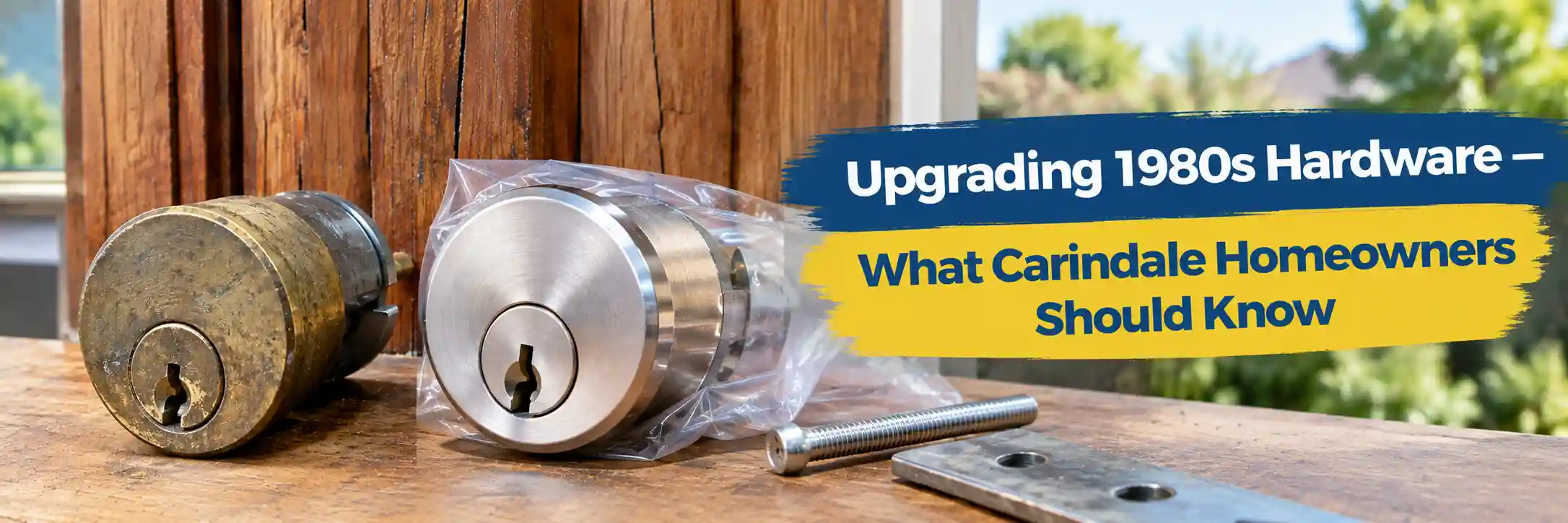
Old lock upgrades in Carindale address the specific security situation of a suburb whose entire residential character was established in a four-year period — 1976 to 1980 — when the Carindale housing estate was developed. The locks, deadbolts, and hardware installed in those original Carindale family homes are now between 45 and 50 years old. Old lock upgrades in Carindale for these properties involve understanding what Queensland’s subtropical climate does to hardware over nearly five decades, and what the gap between a lock’s appearance and its actual current security performance looks like.
What Brisbane’s climate does to 1980s lock hardware
Old lock upgrades in Carindale start with the climate dimension that distinguishes Brisbane residential hardware from Adelaide or Melbourne equivalents. Queensland’s subtropical climate subjects outdoor and semi-exposed hardware to conditions that accelerate degradation in specific ways:
Humidity cycling is the primary mechanism. Brisbane’s wet season — December through February — brings high humidity that penetrates seals, promotes corrosion inside cylinder mechanisms, and causes timber door frames to swell. The dry season contracts everything back. Forty-five cycles of this movement have worked on every piece of hardware in a 1978 Carindale home in ways that would not have occurred in a drier climate.
UV degradation affects seals, gaskets, and polymer components in lock mechanisms. Hardware exposed to Queensland’s intense summer sun degrades faster than the same hardware in a shaded environment. South or west-facing external hardware receives the most UV exposure and tends to degrade fastest.
Temperature extremes stress metal components. Brisbane’s summer heat — 35°C or above on many days — expands metal components, and the cool of Brisbane winter contracts them. The cumulative stress of these cycles over 45 years contributes to the mechanism wear that old lock upgrades in Carindale consistently find.
The assessment — old lock upgrades Carindale starting point
Old lock upgrades in Carindale begin with the same two-step assessment that applies to any established property. Neither step requires tools or a locksmith.
The key feel test: insert each key into each external cylinder and assess the operation. The key should slide in smoothly without preferring a specific angle. It should rotate with moderate force in a smooth, unresisted arc. Any technique required — a slight upward pressure on the key, a preference for a specific insertion angle, extra force at the end of the rotation — indicates that the cylinder mechanism has developed wear or corrosion that is affecting its operation. A cylinder that requires technique has worn past its specification. It should be replaced, not rekeyed — rekeying a worn cylinder changes the key configuration but does not address the internal wear.
The push test: engage each external deadlock and push firmly at the lock position. The door should not move. Any frame movement means the strike plate screws are not providing structural resistance. In Brisbane’s climate, Queensland hardwood timber door frames can check and split along the grain in ways that reduce screw pull-out strength even when the timber looks sound on the surface. The push test identifies this regardless of the frame’s visible condition.
The Queensland hardwood frame — old lock upgrades Carindale specific
Old lock upgrades in Carindale for the 1976-1980 housing stock involves the specific characteristics of Queensland hardwood timber door frames that differ from softwood frames used in many southern states. Queensland hardwood — typically hardwood species appropriate for subtropical construction — has high density and durability. But it also checks along the grain in dry conditions and can split at fastener points under sustained stress.
Strike plate screws in a Queensland hardwood frame that has checked or split at the fastener points may appear to be held firmly — the screw turns down to resistance and the plate sits flush — while providing significantly reduced pull-out strength. The push test reveals this regardless of how the fastener appears on the surface. Strike plate reinforcement in Queensland hardwood uses 75mm screws with a pilot hole sized for the specific hardwood density, into the structural framing behind the jamb. A locksmith who is familiar with Queensland hardwood construction will assess the frame condition before specifying the reinforcement length.
The key history in a 45-year Carindale home
Old lock upgrades in Carindale have a key history dimension that reflects the suburb’s owner-occupier character. Carindale’s 85% owner-occupancy rate means many of the suburb’s family homes have been in the same family since the 1976-1980 estate development. A home that has been in continuous family ownership for 45 years has a key history that reflects that entire tenure.
The key history of a Carindale family home occupied since 1978: adult children who had keys when they lived at home and who may still have them after moving out; a trusted neighbour who was given a key during an extended family holiday and whose copy was never retrieved; a plumber who was given a key during a major renovation and who may still have it. None of this is careless — it is the accumulated key distribution of 45 years of family life. Old lock upgrades in Carindale should always include rekeying with restricted blanks as the final step, establishing a clean key count from the upgrade date regardless of how long and complex the previous history was.
What to replace and what to rekey — old lock upgrades Carindale
Old lock upgrades in Carindale follow a clear decision logic once the assessment is done. Hardware that is mechanically sound — cylinder operates smoothly, bolt throws fully, frame passes the push test — is a rekeying candidate. The mechanism is fine; only the key configuration needs to change.
Hardware that fails the assessment — cylinder requiring technique, bolt that does not throw freely, frame that flexes under push — needs replacement, not rekeying. The specific replacement decision:
- Worn cylinder: replace with a current AS 4145.2-equivalent rated cylinder. On restricted blanks from installation.
- Stiff or incomplete bolt throw: replace the full lock. The bolt mechanism is worn past the point that lubrication addresses.
- Frame flex: reinforce the strike plate with 75mm screws into structural framing. This is the repair that produces the most security return for the least investment.
- Hardware at or past its design life with no specific fault: replacement is still the better investment. A 45-year-old lock that is currently functioning adequately is closer to failure than a new one regardless of the assessment result.
Restricted blanks — old lock upgrades Carindale key management
Old lock upgrades in Carindale should specify restricted key blanks on every new or rekeyed cylinder. Restricted blanks cannot be cut at a hardware store or key kiosk — copies require going back to the authorising locksmith. For a Carindale family home with 45 years of informal key distribution, restricted blanks mean that the key history from the upgrade date is controlled. Every future key copy is a documented event. No family member, contractor, or visitor can make an informal copy without the household knowing.
For Carindale homeowners doing old lock upgrades after a long period without one, the opportunity to review the full key distribution across the household and the trusted community is as valuable as the hardware upgrade itself. Who has a key? Where are the copies? Is the count something that can be stated confidently? The restricted blank specification from the upgrade date means that answering these questions becomes progressively easier over time — because every subsequent copy is a documented event.
Old lock upgrades in Carindale in the suburb’s long-tenure owner-occupier community have a specific community dimension. The trusted neighbour who holds a spare key for a Carindale family home has often been doing so for decades — the relationship that the cul-de-sac community generates means that the neighbour with a spare key is a real, trusted person who provides genuine emergency access value. This arrangement should be part of the key management documentation that an old lock upgrade produces: the new restricted blank key count should include the trusted neighbour’s copy as a named, documented holder — not an informal arrangement that exists outside the formal key count.
The Carindale community and key management
A 45-year-old deadlock that fails the push test — because the strike plate screws no longer provide structural resistance — may not meet the policy’s effective security condition even if the deadlock is technically in place and engaged. Reviewing the home insurance policy’s security conditions alongside the old lock upgrade assessment is the step that ensures the upgrade produces both genuine security and compliant insurance coverage.
Old lock upgrades in Carindale have an insurance dimension that some homeowners are unaware of until a claim is made. Some home and contents insurance policies have conditions specifying the standard of lock hardware required for the policy’s security conditions to be met. A policy that specifies a deadlock must be fitted and engaged on all external doors as a condition of coverage may have specific requirements about the specification of that deadlock.
Insurance and 1980s hardware — old lock upgrades Carindale
Conclusion
Old lock upgrades in Carindale address what Queensland’s subtropical climate does to 45-year-old hardware — worn cylinder mechanisms, frame movement from humidity cycling, and accumulated key histories spanning decades. The key feel test, the push test, and the replacement or rekeying decision with restricted blanks establish the security foundation that original 1976-1980 hardware no longer provides on its own.