
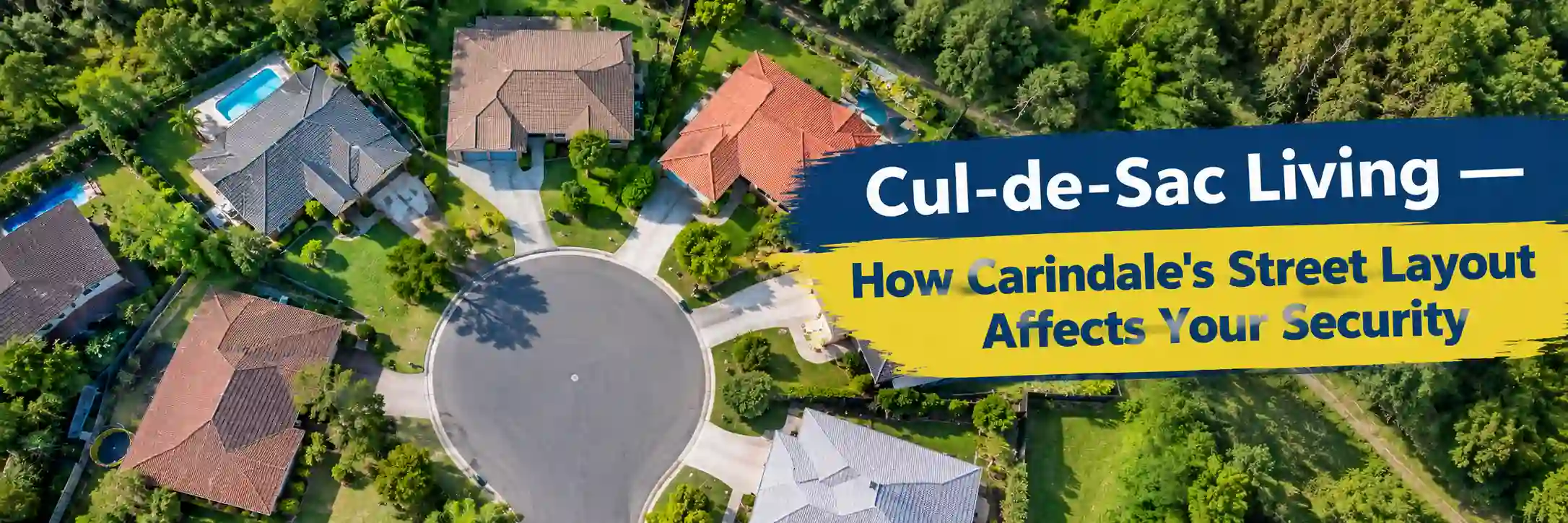
Cul-de-sac security in Carindale is worth understanding because the suburb’s entire residential character was shaped by the estate planning of the 1976-1980 development period. Carindale was purpose-designed as a residential estate — not a grid of through-streets, but a network of cul-de-sacs, courts, and closes that gave each cluster of homes a defined neighbourhood unit with limited through-traffic. Cul-de-sac security in Carindale addresses both what this street design provides for residential security and what it does not — because the two are genuinely different from standard through-street security assumptions.
What the cul-de-sac design provides
Cul-de-sac security in Carindale benefits from the natural surveillance advantage that the street design creates. A cul-de-sac is, by design, a street with one entry point. Every vehicle that enters the cul-de-sac has a reason to be there — a resident, a visitor to a resident, a delivery, or a service provider. Vehicles that cruise through a grid street have no particular reason, no identification, no connection to the community.
In Carindale’s cul-de-sacs and courts, every vehicle is either familiar or notable. Long-term residents who have lived in the same Carindale court since the 1970s or 1980s know every car that regularly parks in their street. An unfamiliar vehicle that parks in a Carindale cul-de-sac and sits without obvious purpose is noticed by multiple households. This natural surveillance is not organised or intentional — it is the product of the community familiarity that cul-de-sac design generates.
This is a genuine security benefit. Carindale’s cul-de-sac network is one of the reasons the suburb has a family-safe reputation in Brisbane’s eastern suburbs. The design creates the community familiarity that makes vehicle-based opportunistic targeting less effective than in a through-street grid.
What the cul-de-sac design does not provide
Cul-de-sac security in Carindale has important limitations that the design’s advantages sometimes obscure. Understanding these is as important as understanding the benefits.
The cul-de-sac design is about the street. It creates natural surveillance for what happens on the street and at the front of properties facing the street. It does not extend to what happens at the side or rear of properties in any way that differs from any other suburban layout. A Carindale cul-de-sac property whose side passage faces a reserve, a bikeway, a creek corridor, or any public access space has the same rear boundary security considerations as a property on a through-street — the cul-de-sac’s surveillance benefit stops at the front boundary.
There is also a specific cul-de-sac dynamic that occasionally produces a false sense of security. Because the street feels safe — and is statistically safer at the front — some Carindale cul-de-sac residents transfer that safety assumption to the rear and sides of their properties without examining whether it applies. The rear sliding door with its original builder-grade latch, the side gate with the turn-and-lift mechanism, the back fence adjacent to a reserve — these are not protected by the cul-de-sac’s natural surveillance. They need individual assessment regardless of the street design.
Foot traffic in Carindale cul-de-sacs — the nuanced picture
Cul-de-sac security in Carindale has a foot traffic dimension that the vehicle-centred cul-de-sac security discussion often misses. While vehicle through-traffic in a Carindale cul-de-sac is effectively zero, foot traffic does not follow the same pattern. Pedestrians do not need to have a destination in the cul-de-sac to walk through it.
Carindale’s bikeway network and the connections between reserves and creek corridors create pedestrian paths that sometimes run through residential areas. A Carindale resident who walks to the Bulimba Creek path from a non-adjacent street may walk through a cul-de-sac or court as part of a pedestrian route that makes no vehicle sense. The foot traffic in Carindale’s cul-de-sac network is lower than on through-streets but is not zero, and it is less predictable than vehicle traffic.
Cul-de-sac security in Carindale for side passages that face toward pedestrian desire lines — the informal walking routes that connect bikeway access points with residential streets — should be assessed with this pedestrian context in mind. A side gate with a turn-and-lift latch on a Carindale cul-de-sac property adjacent to an informal pedestrian connection to the reserve or bikeway is not protected by the cul-de-sac’s vehicle surveillance benefit.
The community familiarity asset — cul-de-sac security Carindale
Cul-de-sac security in Carindale is substantially supported by the community familiarity that long-tenure neighbours generate. Carindale’s 85% owner-occupancy rate and the suburb’s estate origin mean that many Carindale cul-de-sacs have residents who have been neighbours for decades. These long-term residents know each other, know each other’s visitors, and notice when something is different in the street.
For newer Carindale residents — buyers who have purchased in a cul-de-sac where the other residents have been there since the 1980s — integrating into this community is both a social pleasure and a security asset. The new family in the court who introduces themselves to their neighbours, who is known by name within a few months of moving in, becomes part of the surveillance network that the cul-de-sac design enables. The family who moves in and remains private and unconnected to their court neighbours does not benefit from the community asset in the same way.
Hardware calibrated to the cul-de-sac context
Cul-de-sac security in Carindale for the specific hardware priorities of properties in this street design:
The front entry and street-facing hardware benefits from the cul-de-sac’s natural surveillance and does not need extraordinary attention beyond ensuring the hardware is sound and the key history is managed. The front of a Carindale cul-de-sac property is in one of Brisbane’s more naturally surveilled residential street environments.
The rear and side hardware needs full independent assessment regardless of the cul-de-sac context. The patio sliding door, the rear gate — particularly for properties adjacent to reserves, bikeways, or creek corridors — the side gate, and the pool gate if present all require assessment that is not affected by the cul-de-sac’s street-facing surveillance benefit.
The specific Carindale cul-de-sac security priority list therefore inverts the usual suburban security assumption: the front is relatively well-served by the design; the rear and sides need the attention that the design does not provide.
The settlement-week introduction — knocking on a couple of immediate neighbours’ doors, introducing the family, mentioning the move-in — is the action that begins the integration into the court community. It is both the right social approach in an established community and a practical security step. The court that knows the new family has arrived is the court that notices if anything unusual happens at the new property before the family has established their own security routines.
Cul-de-sac security in Carindale for new residents — families who have recently purchased in one of Carindale’s established courts — has a specific onboarding dimension. Moving into a Carindale cul-de-sac where the other residents have been neighbours for twenty or thirty years means joining a community with established patterns and relationships. The new family whose vehicle is unfamiliar to the court, whose routines are not yet known, and whose name the neighbours do not yet know is not yet part of the surveillance network that the cul-de-sac design enables.
New residents in a Carindale cul-de-sac
For Carindale cul-de-sac residents who travel during school holidays, the community that makes their court feel safe during normal periods is also the community that notices their absence during holidays. Informing immediate neighbours of a planned absence — and asking them to contact you if anything looks unusual at the property — converts the cul-de-sac’s existing community awareness into a specific, active caretaking arrangement.
In Carindale’s long-established cul-de-sac courts, this conversation is usually warmly received by neighbours who are already attentive to the street’s normal patterns.
Cul-de-sac security in Carindale during school holidays has a specific dimension. Carindale is a family suburb — 52.5% couple families with children — and school holidays produce a recognisable pattern of vehicle absence in the suburb’s cul-de-sacs. A court where several family households leave during school holidays has a noticeable change in the normal occupancy pattern that the court’s community familiarity usually makes obvious.
The cul-de-sac and school holiday security
Westfield Carindale also contributes to the cul-de-sac security context for properties near the shopping centre perimeter. The large retail centre generates vehicle and foot traffic in the surrounding street network that differs from the cul-de-sac design’s low-through-traffic assumption. Carindale cul-de-sacs immediately adjacent to Carindale’s arterial road connections — Creek Road, Old Cleveland Road — experience more through-pedestrian traffic than the suburb’s quieter interior courts. The security calibration for these properties reflects both the cul-de-sac design benefit and the arterial adjacency context, applying the same side gate and rear boundary assessment that applies to any commercial-adjacent residential property in Brisbane’s eastern suburbs.
Conclusion
Cul-de-sac security in Carindale provides genuine natural surveillance at the front of properties and genuine community familiarity from long-tenure neighbours. It does not extend to the rear and sides of properties, which require individual hardware assessment regardless of the street design. The security calibration for a Carindale cul-de-sac property correctly focuses on the rear sliding door, rear gate, and pool gate that the cul-de-sac design leaves unaddressed.