
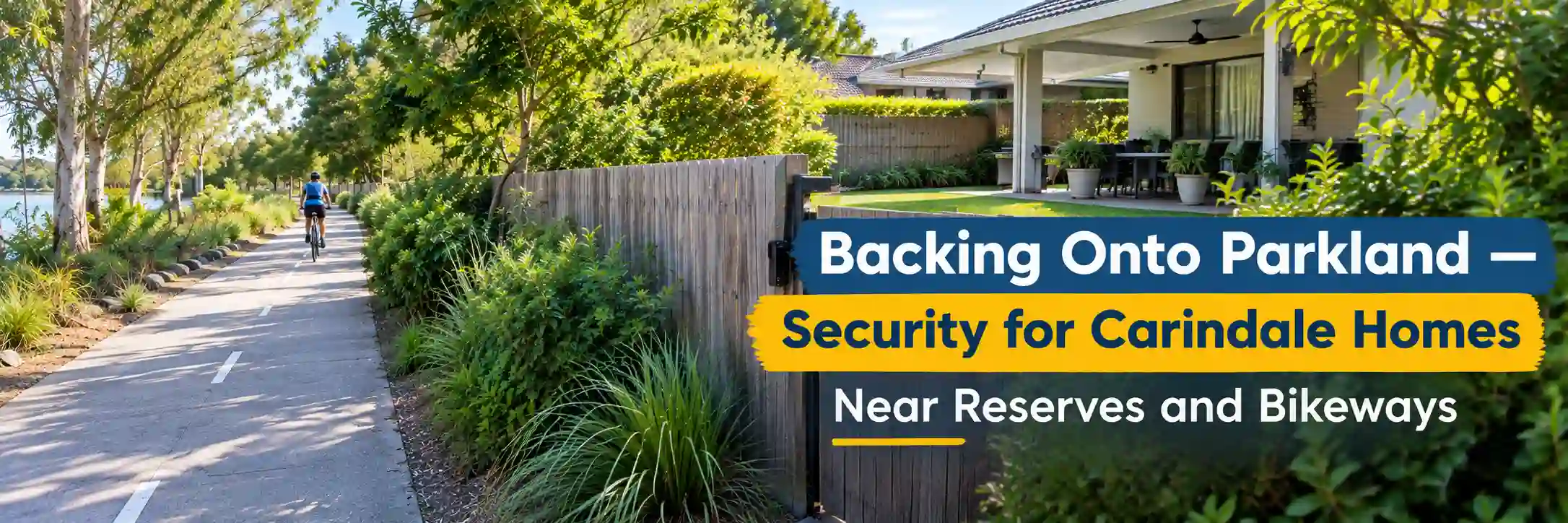
Homes backing bushland in Carindale have a rear boundary situation that most residential security guides never address — because most suburbs do not have it in the same way. Carindale’s planning zones tell the story: conservation zones cover 10.48% of the suburb and recreation and open space covers 16.97%. Bulimba Creek runs through the suburb.
The Belmont Bushland Reserve borders residential properties. Brisbane City Council’s bikeway network connects these green spaces with public paths that run adjacent to residential rear boundaries across significant sections of Carindale. Homes backing bushland in Carindale with these public green corridors at their rear have a fundamentally different security context from properties bounded by private neighbours on all sides.
What the bushland boundary creates for security
The standard suburban security assumption is mutual natural surveillance — your rear neighbour is in their backyard at various times of day, and their presence provides incidental observation of what happens at your shared boundary. An unfamiliar person near your rear fence is noticed because your neighbour sees them.
Homes backing bushland in Carindale do not have this. The Bulimba Creek corridor, the Belmont Bushland Reserve trails, and Brisbane City Council’s bikeway network are public spaces. The people who move through these spaces — cyclists on the bikeway, walkers on the trail, dogs and their owners in the creek-side green space — are not residential neighbours.
They are members of the public who have no connection to the residential properties beside the path. And unlike a quiet suburban street where an unfamiliar person near a property would stand out, a bushland path is a normal environment for unfamiliar people to be present without anyone finding it noteworthy.
The rear boundary of a home backing bushland in Carindale is adjacent to a continuously active public space with no residential surveillance. This is the specific security condition that these properties create — and it is the one that standard security advice does not address.
The rear gate — home backing bushland Carindale priority
Homes backing bushland in Carindale almost universally have a rear gate that provides access between the public green space and the residential property. This gate was often included in the original construction as a convenience — access to the bikeway for a morning ride, access to the creek walking track for an evening walk. It is a genuine amenity of backing onto bushland in Carindale.
The security question is simple: can that gate be operated from the public path side without a key? A turn-and-lift latch — the standard gate hardware on most Carindale family homes built in the 1976-1980 estate period — can be operated from the path side without a key. Anyone walking, cycling, or running past the rear boundary can approach the gate and open it. This is an uncontrolled access point between a public bushland corridor and the rear of a private family home.
A keyed gate lock converts this from uncontrolled to controlled. The convenience of the gate for the family remains — but it requires a key to operate from the outside. For homes backing bushland in Carindale, this is the single security upgrade with the highest return relative to its simplicity.
The rear entry hardware — home backing bushland Carindale
Homes backing bushland in Carindale built in the 1976-1980 estate period have rear entry hardware that reflects their original construction era. The rear door of a 1978 Carindale family home backing onto Bulimba Creek is, in most cases, a lighter door with lighter hardware than the street-facing front entry — because the front has received attention over forty-five years of ownership and the rear has whatever was installed at construction.
The push test on the rear door of a bushland-backing Carindale home is worth doing this week. Engage the deadlock and push firmly at the lock position. Frame movement means the strike plate screws are not providing structural resistance. In Queensland’s subtropical climate, where timber door frames swell and contract with the humidity cycle, this finding is extremely common in 1970s and 1980s housing stock.
The rear door that backs onto public bushland warrants the same hardware specification as the front entry — because it is the entry with the least natural surveillance from outside the property.
Lighting — home backing bushland Carindale
Homes backing bushland in Carindale have a specific after-dark lighting gap. The bushland path — Bulimba Creek corridor, bikeway, reserve trail — may have Brisbane City Council path lighting in some sections. Residential properties cannot rely on council path lighting for their own rear boundary security. The residential lighting that matters is motion-activated lighting installed by the homeowner, covering the rear boundary from the path side.
The light should activate when someone approaches from the public path toward the rear boundary — not when someone is already at the back door. Coverage that begins at the fence line changes the effective deterrent zone from the door area to the full rear approach. For a Carindale family home where the rear boundary faces a bikeway used by hundreds of people per day, motion-activated rear boundary lighting that activates from the path side is more relevant than the equivalent lighting on a property bounded by private neighbours.
Brisbane City Council easements and the bushland boundary
Homes backing bushland in Carindale in the creek corridor and reserve boundary areas may have Brisbane City Council drainage or bushland easements at the rear boundary. Before installing any gate, fencing, or structures at the rear boundary adjacent to council-managed bushland or creek corridors, confirming the easement conditions with Brisbane City Council is the step that prevents a compliance issue after the work is done.
The Brisbane City Council’s online mapping tools show easement locations for most residential properties. A locksmith can advise on gate hardware for any approved rear gate — the easement assessment is the planning step that should precede any physical works at the bushland boundary.
The Bulimba Creek bikeway context
Homes backing bushland in Carindale adjacent to the Bulimba Creek bikeway have a specific context. The bikeway is a Brisbane City Council facility used by commuter cyclists, recreational riders, and families — a daily-use transport and recreation corridor, not just a weekend amenity. This means the path-side activity at the rear boundary of bikeway-adjacent Carindale properties is consistent throughout the day, not just at peak recreational times.
The combination of consistent path activity and the absence of residential rear surveillance creates the specific security profile that homes backing bushland in Carindale need to address. The keyed rear gate, the rear door hardware assessment, and the motion-activated rear boundary lighting together address what the Bulimba Creek bikeway creates for adjacent residential properties in a practical and proportionate way.
Managing rear boundary vegetation to maintain sightlines from the house to the rear gate — while keeping the privacy screening character of the garden — is a specific task for homes backing bushland in Carindale. A rear boundary that cannot be observed from the living areas, combined with a rear gate with a turn-and-lift latch, is a more significant security concern than either element alone.
Homes backing bushland in Carindale often have established garden vegetation at the rear boundary that has grown over decades to provide privacy screening between the property and the adjacent public space. This vegetation serves its privacy purpose well. It also reduces visibility from inside the house to the rear boundary — the household cannot see the rear gate and rear fence from the main living areas because the garden screening works in both directions.
Vegetation and visibility — home backing bushland Carindale
The security consideration for Carindale properties adjacent to the Pacific Golf Club is primarily the after-hours context — early mornings and evenings when the course is quiet. The rear boundary that faces a golf course fairway during daylight golfing hours has some incidental observation from golfers.
The same boundary during pre-dawn or after-dusk hours is effectively unobserved from any direction. The keyed rear gate and rear boundary motion lighting remain the relevant security measures regardless of the specific nature of the adjacent land.
Homes backing bushland in Carindale adjacent to the Pacific Golf Club boundary have a specific rear boundary context. The golf course represents a large area of semi-public land — accessible to golfers and club members but not to the general public in the same way that the Bulimba Creek bikeway is. Properties adjacent to the golf course boundary have a rear fence adjacent to a large, largely unobserved green space during the hours when the course is not in active use.
The Pacific Golf Club boundary — home backing bushland Carindale
Conclusion
Homes backing bushland in Carindale have a rear boundary security context that private-neighbour-bounded properties do not share. The keyed rear gate, the rear door push test and hardware assessment, and the motion-activated rear boundary lighting together address what adjacent public bushland and bikeway corridors create for Carindale family homes.