
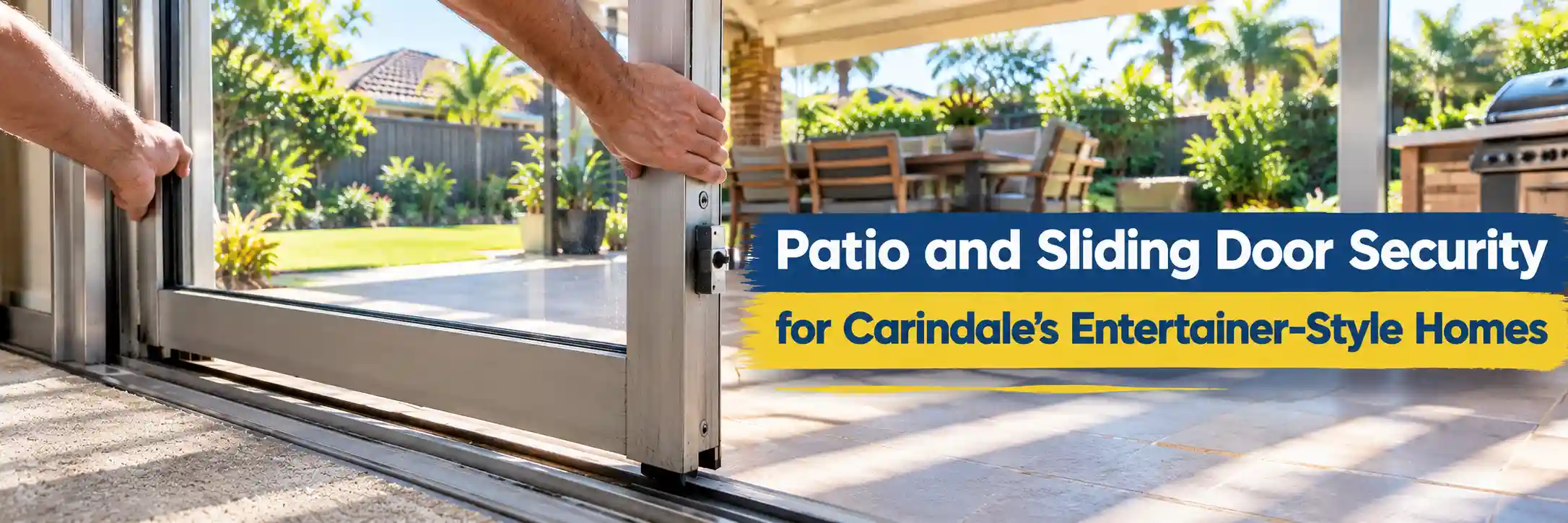
Sliding door security in Carindale is the conversation that applies to most family homes in the suburb — because most Carindale homes built in the 1976-1980 estate period were designed with the entertainer’s lifestyle in mind. Large sliding glass doors opening onto covered patios, alfresco areas, and the backyard that is central to Brisbane family living. Sliding door security in Carindale addresses the gap between how important these doors are to the way families use their homes and how little security attention they typically receive compared to the street-facing front entry.
Why sliding doors are the weakest point in most Carindale homes
Sliding door security in Carindale starts with understanding why this is a consistent finding across the suburb’s family homes. The front door of a Carindale family home has received security attention across forty-five years of ownership — it faces the street, it is the formal entry, and it gets noticed when it needs maintenance or upgrading. The patio sliding door faces the backyard and the covered alfresco area. It was designed for access and entertainment, not formal entry. The security hardware it received at original installation in 1978 or 1979 was builder-grade.
That original builder-grade sliding door flipper latch — which is still the primary security mechanism on many Carindale patio doors — provides almost no resistance to entry. The flipper latch is a panel-positioning device, not a security lock. It keeps the door closed during normal use. It does not prevent the door from being lifted off the lower track, which bypasses the latch entirely. It does not provide significant resistance to a sideways force at the latch position.
In a suburb where 85% of properties are owner-occupied and families have lived in the same home for decades, this situation has often gone unexamined. The door has always been closed and latched. Nothing has gone wrong. The assumption of security has never been tested.
The two tests — sliding door security Carindale
Sliding door security in Carindale assessment requires two tests that together identify the specific gaps.
Test one: the lift-off test. Close the patio sliding door and engage the flipper latch. Now try to lift the door upward while pushing outward on the panel. On most 1970s and 1980s aluminium sliding doors, the door will lift slightly off the lower track even with the latch engaged. If the door lifts at all, the latch is irrelevant — the door can be removed from the opening from outside without overcoming the latch at all. An anti-lift device fitted in the upper track prevents this. It is a simple, low-cost installation that makes the lift-off method impossible.
Test two: the latch bypass test. With the anti-lift device fitted, close the door, engage the latch, and push firmly inward at the latch position while applying sideways force. A worn or misaligned flipper latch on a 45-year-old aluminium door may release under moderate force. If it does, a secondary keyed lock or a floor bar provides the resistance that the flipper latch alone cannot. The floor bar — a metal bar dropped into the track behind the closed door — is inelegant but completely reliable.
What 45 years does to aluminium sliding door systems
Sliding door security in Carindale for the suburb’s original housing stock involves an additional assessment layer: the condition of the door system itself after four and a half decades of Brisbane’s climate. Queensland’s subtropical environment is demanding on aluminium sliding door systems — UV degradation of seals and gaskets, corrosion at the roller wheel assemblies, track debris accumulation, and the humidity cycling that affects every component.
A door that does not close smoothly and latch reliably every time is a door that will sometimes not be fully secured. The most common cause in Carindale’s older homes is dirty or damaged roller wheels — the wheels have corroded or accumulated debris, the door sticks and requires lifting to move, and the household has unconsciously developed a technique for closing it that they do not always apply. A door that requires technique to close is a door that will not be closed reliably.
Track cleaning — vacuum the track channel, wipe with a damp cloth, apply a silicone spray — is the maintenance that keeps older Carindale sliding doors rolling smoothly. Clean rollers, aligned tracks, and smooth operation are the foundation that makes the security hardware effective. A keyed lock on a door that the household struggles to close will not be engaged every time.
The aluminium frame condition — sliding door security Carindale
Sliding door security in Carindale for the oldest housing stock should include a frame condition assessment. Press firmly at the corners of the door frame. Any flex or movement means the aluminium frame has lost structural integrity — from UV degradation, from hinge stress over decades, or from the ground movement that Brisbane’s expansive clay soils produce during wet-dry cycles. A door lock on a structurally compromised frame is not providing the resistance its specification suggests.
Where frame condition has deteriorated significantly, replacement of the sliding door system — with a current-specification door that includes proper security hardware from installation — is the solution that addresses both the security and the condition issues simultaneously. For a Carindale family home where the patio sliding door opens onto the entertaining area and is the primary connection between indoor and outdoor living, a new door with contemporary security specification is a meaningful improvement to both function and safety.
The bifold and stacker door alternative
Sliding door security in Carindale for newer Carindale homes, or for original homes that have had entertainment area renovations, often involves bifold or stacker door systems rather than the traditional two-panel sliding door. These systems have different security considerations.
A bifold door system that opens wide across the full entertainment area width cannot have an anti-lift device fitted in the same way as a standard sliding door. The security for a bifold system focuses on the lead panel lock — the mechanism that engages when the system is in the closed position — and the floor lock that drops into the track. A stacker door system has its own specific locking and security hardware that differs from a two-panel slider. A locksmith who assesses the specific door system type will specify the appropriate security hardware rather than applying a standard slider solution to a different door type.
A Carindale family home with a secondary keyed lock on the patio sliding door — requiring a deliberate, specific action to secure the door beyond simply sliding it shut — is more reliably secured than one where the only security is the flipper latch that the household engages as part of a single smooth motion. The secondary lock changes the sliding door security from a one-step action to a deliberate two-step action, which means it is engaged consciously rather than habitually — and is therefore more reliably engaged when the household is absent.
Sliding door security in Carindale in the entertainer home context has a specific key management dimension. A Carindale family home that hosts regular gatherings — backyard barbecues, children’s parties, Christmas and Easter family events — has its patio sliding door open frequently and has many people moving through it. The key management question for the entertainer home is not about the lockout scenario but about who has keys to the property and whether the sliding door is consistently secured when the household is not home.
The entertainer home and key management — sliding door security Carindale
Security screen doors for Carindale patio entries should specify stainless steel or aluminium mesh rather than powder-coated steel mesh. In Brisbane’s subtropical outdoor environment, powder-coated steel mesh corrodes at cut edges, scratches, and any point where the coating is compromised — producing rust staining and eventually structural weakness in the mesh. Marine-grade aluminium or stainless mesh resists the Brisbane climate and maintains its structural integrity for significantly longer.
Sliding door security in Carindale has an additional layer that many Carindale family homes have already recognised as important for Brisbane’s climate: the security screen door. A security screen door fitted on the exterior of the sliding glass door provides an additional physical barrier before the glass sliding door itself — and in Brisbane’s climate, it also provides ventilation without the full glass sliding door needing to be open.
The security screen door option for Carindale patio entries
For Carindale family homes where the patio sliding door is also the connection to the pool area — where the sliding door opens onto a covered patio that leads to the pool — the sliding door security works in conjunction with the pool gate to form a two-layer barrier between the interior of the home and the pool. A properly secured sliding door and a compliant pool gate together provide the residential security and the Queensland pool safety compliance that Carindale family homes with this layout require. Neither substitutes for the other — both warrant independent assessment.
Conclusion
Sliding door security in Carindale addresses the most consistently under-secured entry point in the suburb’s family homes — the patio sliding door whose builder-grade flipper latch has been the primary security for four decades. The lift-off test and the latch bypass test together identify the specific gaps. The anti-lift device and secondary keyed lock or floor bar together close them in a single locksmith visit.